
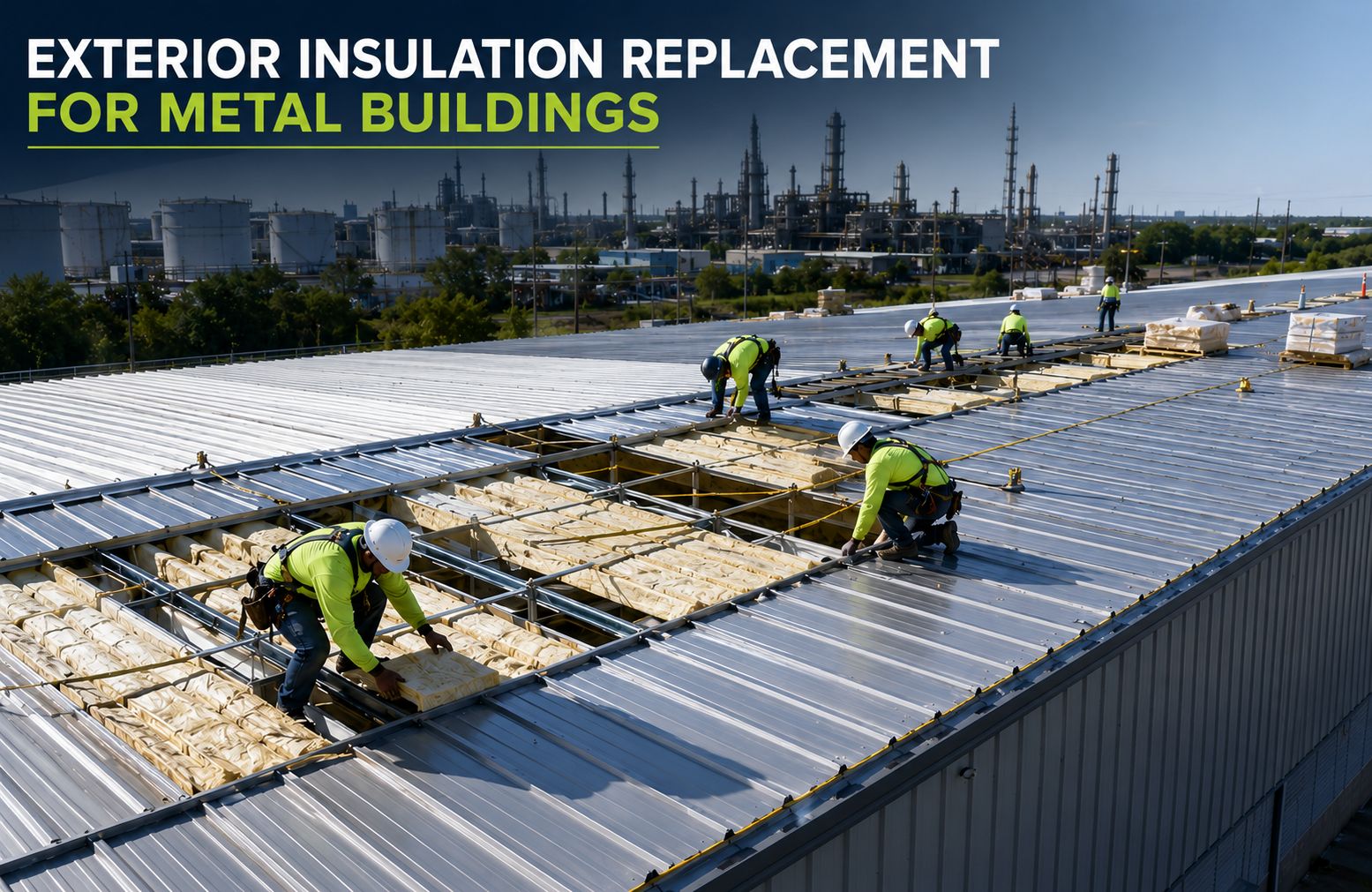
Exterior Insulation Replacement for Metal Buildings With Minimal Operational Disruption
For many industrial facilities in Houston, shutting down operations isn’t an option. Production lines, storage systems, and heavy machinery often make interior access nearly impossible, especially when insulation systems need to be replaced.
That’s where exterior insulation replacement for metal buildings becomes a practical solution.
Rather than performing work from inside the building, contractors access the insulation system through the roof or wall exterior. This approach can help facility managers improve energy efficiency, address condensation issues, and enhance building performance while minimizing disruption to ongoing operations.
In many cases, a metal building insulation retrofit is performed as part of a roof retrofit, roof restoration, or roof replacement project where access to the insulation system is already available.
If your insulation is failing but production downtime must be minimized, an exterior approach may be the most efficient path forward.
When Interior Access Isn’t Feasible
In many commercial and industrial environments, interior insulation work is difficult or impractical.
Common Challenges Inside Metal Buildings
• Heavy machinery or production lines that cannot be moved
• High-bay storage or racking systems blocking access
• Sensitive environments such as food processing or clean rooms
• 24/7 operations where shutdowns result in lost revenue
• Safety concerns with overhead work in active spaces
In these situations, traditional interior retrofits can be disruptive and costly to coordinate.
One of the main advantages of exterior-access insulation replacement is allowing crews to complete the project while operations continue below.
Step-by-Step: How Exterior Insulation Replacement Works
Exterior replacement is typically performed in controlled sections to maintain building integrity and weather protection.
1. Roof Panel Removal or Lift
Metal roof panels are carefully removed or lifted in phases to expose the insulation system beneath. Panels are reused when conditions allow.
2. Removal of Existing Insulation
Old insulation that is compressed, deteriorated, or moisture-saturated is removed. This is especially important in Houston’s humid climate, where trapped moisture can lead to corrosion and performance issues.
3. Structural and System Inspection
Once the insulation is exposed, crews inspect key components, including:
- Structural framing and purlins
- Fasteners and clips
- Vapor barriers and existing assemblies
Any signs of corrosion, water intrusion, or structural deterioration should be evaluated and addressed before new insulation is installed.
4. Installation of New Insulation System
New insulation is installed using updated materials that may include:
- Fiberglass or rigid board insulation with improved R-values
- Moisture-control components such as vapor retarders, facing systems, and air-sealing details designed to help manage condensation.
- Reflective facings to reduce radiant heat gain
This creates a more consistent and efficient thermal envelope.
5. Fastener Replacement and System Improvements
Because the roof system is already open, many projects include:
- Replacement of aging or backed-out fasteners
- Upgraded washers and installation of closures
- Reinforcement of panel attachment
This can help improve overall roof performance and reduce future maintenance needs.
6. Panel Reinstallation and Sealing
Roof panels are reinstalled and sealed to restore a weather-tight system. Special attention is given to seams, penetrations, and transitions.
7. Final Inspection
A final quality check ensures:
- Proper insulation placement
- Continuity of vapor control layers
- Secure panel attachment
- Weather resistance
Thickness and Performance Considerations
Insulation thickness plays an important role in energy performance, but it is not one-size-fits-all.
What Determines Insulation Thickness
Allowable insulation thickness depends on several factors, including:
- Roof panel profile and geometry
- Structural capacity and load limits
- Fastener length and attachment method
- Drainage requirements and slope
- Transitions at curbs, edges, and penetrations
Each building must be evaluated individually to determine the appropriate system.
Performance Tradeoffs
| Factor | Lower Thickness | Higher Thickness |
| Upfront Cost | Lower | Higher |
| R-Value | Moderate | Higher |
| Energy Savings | Moderate | Greater potential |
| Installation Complexity | Simpler | More complex |
Key Insight
In Houston’s climate, moisture control is just as important as insulation thickness. Proper condensation control, air sealing, and assembly design can significantly impact overall performance.
When Roof Replacement and Insulation Replacement Should Be Combined
In many facilities, insulation replacement is most cost-effective when completed as part of a roof retrofit, roof restoration, or roof replacement project.
Because roof panels are already being removed or modified, combining these scopes can help reduce labor costs, streamline construction sequencing, and improve overall building performance.
Potential benefits may include:
- Improved thermal performance
- Enhanced moisture and condensation control
- Reduced disruption compared to separate projects
- Opportunities to address aging fasteners and roof components
- Extended service life of the roof system
For facilities with both roofing and insulation concerns, evaluating the entire building envelope often provides the greatest long-term value.
Addressing Fasteners During Exterior Work
Commercial metal building insulation replacement creates an opportunity to improve other parts of the roof system at the same time.
Over time, fasteners can loosen due to expansion and contraction, leading to leaks and system wear.
Because panels are already removed during the process, we typically replace fasteners to improve sealing.
This combined approach can improve system performance and help reduce future maintenance costs.
Scheduling Around Production
One of the main advantages of exterior-access insulation replacement is the ability to work around active operations.
Phased Installation
Projects are typically completed in sections, allowing:
- Continuous operation inside the facility
- Minimal disruption to workflow
- Controlled exposure during installation
Flexible Scheduling
Work can often be scheduled during:
- Weekends
- Off-hours or night shifts
- Planned slow production periods
Weather Planning
In Houston, scheduling must account for:
- Rain events
- High humidity
- Heat conditions
Experienced crews plan work carefully to maintain weather protection throughout the process.
Potential Energy and Operational Benefits
- Reduced HVAC energy usage
- Improved indoor temperature consistency
- Reduced condensation-related damage
- Improved overall building performance
Actual savings vary based on building conditions, utility rates, insulation design, and operational factors.
When Exterior Replacement Makes Sense
Exterior insulation replacement is typically a strong option when:
- Interior access is limited or impractical
- Insulation is wet, sagging, or no longer effective
- Condensation issues are recurring
- Downtime is not acceptable
Common Signs Your Metal Building Insulation Needs Replacement
- Visible sagging insulation
- Persistent condensation
- Rising energy costs
- Water-stained insulation
- Uneven interior temperatures
- Corrosion on roof framing or fasteners
Frequently Asked Questions
1. What is exterior insulation replacement for a metal building?
It is a method of accessing and upgrading insulation through the building exterior, often during a roof retrofit, roof restoration, or roof replacement project.
2. Can this be done without shutting down operations?
Yes, exterior methods are commonly used when facilities need to remain operational.
3. What insulation performance can be achieved?
Performance depends on system design, insulation type, and thickness selected during the project.
4. Is exterior replacement better than interior retrofit?
It depends on the building. Exterior methods are often preferred when interior access is limited.
5. Will this help reduce condensation?
Yes, when properly designed with vapor control, it can significantly reduce condensation issues.
6. Can fasteners be replaced during this process?
Yes, and many projects include fastener upgrades as part of the scope.
7. Will this extend the life of my roof?
It can help extend service life when combined with fastener replacement, sealing improvements, and proper maintenance.
8. What Does Exterior Insulation Replacement Cost?
- Costs vary based on:
- Building size
- Roof condition
- Insulation thickness requirements
- Structural repairs
- Fastener replacement needs
- Access limitations
- Scheduling requirements
Because every facility is different, a site-specific assessment is the most reliable way to determine project costs.
If your facility is experiencing insulation deterioration, condensation issues, rising energy costs, or roof system aging, Metalguard can evaluate your building and recommend a solution tailored to your operational requirements. Contact us today to schedule an on-site assessment and receive a customized insulation and roofing improvement plan. metalguard.com/contact

