
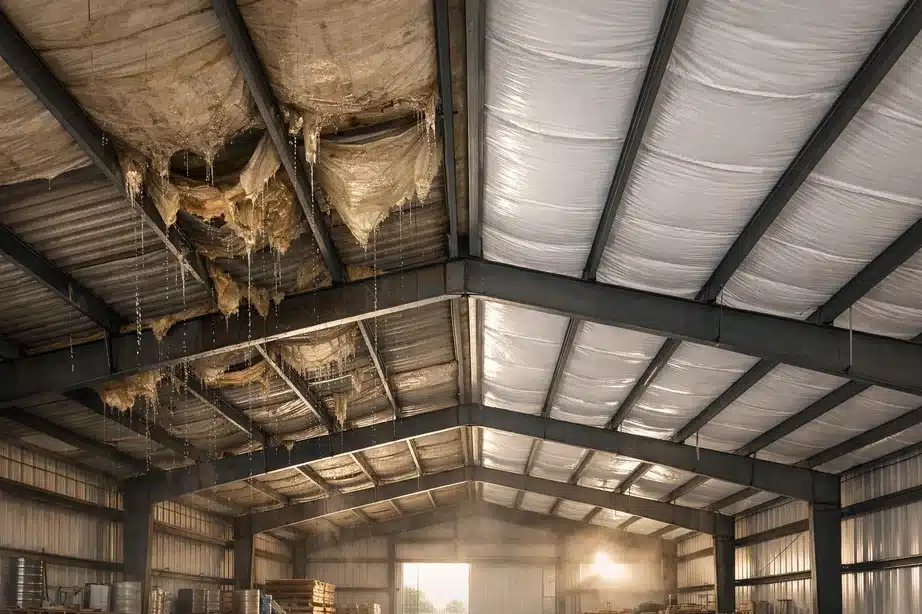
Metal Building Insulation: Retrofit vs. Replacement in Houston & Sugar Land
Metal buildings are designed for strength and versatility, but without proper insulation, they can become uncomfortably hot, humid, and expensive to operate, especially in Houston and Sugar Land. Over time, insulation can sag, tear, trap moisture, or lose its R-value, leading to temperature swings, condensation, and higher energy bills.
If your facility feels hotter in summer, struggles with interior “roof sweating,” or your energy costs keep rising, it may be time to address the insulation system. The key question becomes:
Should you retrofit your existing insulation or replace it entirely?
This guide will help you understand both options, how each affects downtime, costs, and performance, and which approach is best for your building.
Common Pain Points in Houston Metal Buildings
Owners across Houston and Sugar Land often notice the same warning signs when their insulation starts to fail:
- Condensation or dripping water on the underside of roof panels (“roof sweating”)
- Temperature swings that make workspaces too hot in summer and too cold in winter
- Rising utility costs, especially during long cooling seasons
- Mold or mildew odor inside the facility
- Discolored or sagging insulation facings
- Rust or corrosion forming where moisture collects
If you’re seeing any of these symptoms, your insulation is no longer performing as intended. The next step is to determine whether a retrofit can restore performance or if replacement is necessary to eliminate deeper issues.
Retrofit vs. Replacement: Understanding the Difference
Retrofit Insulation
A retrofit involves upgrading or adding insulation to an existing system without removing the roof or wall panels. It’s a minimally invasive process that often includes:
- Adding new insulation over existing layers
- Installing new vapor barriers and facings
- Correcting gaps, tears, or compression in the current insulation
- Reinforcing or re-strapping the insulation to prevent sagging
Retrofits are ideal when the existing insulation is mostly dry and structurally sound but underperforming due to age, humidity, or outdated materials.
Pros:
- Lower cost than full replacement
- Faster installation and minimal downtime
- Can often be done while operations continue
- Improves comfort and condensation control
Cons:
- Limited by available space and thickness constraints
- Won’t fix severe moisture or mold damage
- Lifespan depends on the condition of the existing insulation beneath
Replacement Insulation
Replacement means completely removing the old system, including insulation, facings, and vapor barriers, and installing new materials from scratch. This process restores full performance and eliminates hidden damage or trapped moisture.
Pros:
- Total reset of insulation, vapor barrier, and facing system
- Allows for maximum R-value upgrades
- Resolves long-term moisture or corrosion problems
- Includes full new product warranties
Cons:
- Higher upfront cost
- Longer installation time
- May require temporary access restrictions or phased scheduling
Replacement is the right choice when insulation is saturated, moldy, or delaminated, or if you’re also replacing your metal roof panels.
Interior vs. Exterior Replacement Methods
When planning insulation upgrades or replacement, it’s important to decide whether the work will be done from the inside (beneath the roof) or from the outside (above the panels).
Interior Insulation Work
- Involves installing new insulation under existing panels.
- Uses banding systems or strapping to hold insulation in place.
- Ideal for facilities with clear access to the underside of the roof.
Advantages:
- Can often be done without disturbing roof panels
- Lower labor and equipment costs
- Shorter project timelines
- Minimal exposure to weather during installation
Disadvantages:
- Limited thickness depending on interior clearance
- May be challenging in areas with machinery or storage racks
Exterior Insulation Work
- Requires removing or lifting roof panels to replace insulation from above.
- Common during re-roofing or when existing insulation is saturated.
Advantages:
- Allows installation of thicker insulation for higher R-values
- Provides full access to inspect and replace vapor barriers
- Ensures complete moisture protection and long-term durability
Disadvantages:
- More labor-intensive and weather-dependent
- Requires roof access and temporary work zones
Thickness Constraints:
Exterior replacements can accommodate greater insulation depth, typically 4-6 inches, while interior retrofits are often limited to 3-4 inches depending on the purlin depth and ceiling height.
Cost Ranges & ROI Drivers
Because every metal building is unique, costs can vary based on condition, accessibility, and materials. However, these ballpark ranges apply to most commercial and industrial properties in Houston and Sugar Land.
| Project Type | Typical Cost (per sq. ft.) | Expected Life Extension | Best For |
|---|---|---|---|
| Interior Retrofit | $1.50 – $4.50 | 10–15 years | Buildings with minor insulation wear or moisture issues |
| Exterior Retrofit | $5.00 – $8.00 | 15–20 years | Moderate insulation damage, good roof structure |
| Full Replacement | $8.00 – $15.00+ | 25–30 years | Major damage, mold, or re-roofing projects |
ROI Drivers
Age of building: Older facilities typically see the highest returns after replacement due to improved R-values.
- Access difficulty: Obstructions, height, and equipment placement affect labor time.
- Square footage: Larger spaces benefit from economies of scale.
- Energy efficiency gains: Better insulation reduces HVAC loads by up to 30%.
- Moisture control: Preventing condensation avoids costly rust or corrosion repairs later.
Many Houston facility managers find that energy savings alone can offset retrofit or replacement costs within 3-5 years.
Climate Considerations for Houston & Sugar Land
The Gulf Coast’s unique weather conditions directly affect insulation performance.
Humidity and Dew Point
Houston’s average annual humidity exceeds 75%, and summer dew points often hit the high 70s. Poorly sealed vapor barriers trap this moisture, causing insulation to sweat or grow mold.
Heat Load
With over 260 sunny days a year, uninsulated or under-insulated buildings can reach 120°F inside, making air conditioning systems work overtime.
Storm Resilience
Wind-driven rain and hurricane conditions can expose weaknesses in roof seams and insulation facings. Updated insulation systems from Metalguard include moisture-resistant facings and secure attachment methods designed for Gulf Coast durability.
Energy Code Compliance
Texas energy standards now require higher R-values and better air sealing for metal buildings. Retrofitting or replacing insulation helps bring older buildings up to code while lowering energy consumption.
A Practical Decision Checklist
| Building Condition | Recommended Solution | Why |
|---|---|---|
| Insulation mostly intact, but energy bills increasing | Retrofit | Improve efficiency without major disruption |
| Minor condensation or facing tears | Retrofit | Repair facings and add new layers for better control |
| Visible mold, sagging, or trapped moisture | Replacement | Prevent corrosion and health risks |
| Planning roof replacement | Replacement | Combine both for maximum efficiency |
| Tight schedule, 24/7 operations | Interior Retrofit | Minimal downtime and fast installation |
| Need major R-value increase | Exterior Replacement | Allows thicker insulation layers |
Why Work with Metalguard
Metalguard has decades of experience improving metal building performance across Houston and Sugar Land. Our team specializes in:
Insulation retrofits and replacements for warehouses, plants, and commercial buildings
- Condensation control solutions with advanced vapor barrier technology
- Exterior and interior installation methods that minimize business downtime
- Free on-site inspections and line-item estimates for full transparency
Many facility owners also combine their insulation upgrades with metal roof repairs or coating systems for complete building envelope protection and energy savings.
Pro Tip: Pairing insulation retrofits with roof restoration helps eliminate condensation issues and can reduce cooling costs year-round.
Metal Building Insulation FAQs
Look for sagging facings, water stains, mold, or condensation on interior panels. Rising energy bills are another sign insulation has lost its effectiveness.
Costs range from $1.50-$15.00 per square foot, depending on whether you choose retrofit, partial replacement, or full system replacement.
A retrofit adds new layers or facings over existing insulation, while replacement removes the old material completely for a fresh start.
Yes. Interior retrofits can often be done from below the roof panels using banding systems, minimizing disruption.
Properly installed insulation can last 20-30 years or more when protected from moisture and UV exposure.
Absolutely. Correct vapor barriers and insulation thickness help keep interior surfaces above dew point, preventing condensation.
In most retrofit projects, yes. Metalguard phases installation to keep operations running safely and efficiently.
Improved insulation can reduce energy bills by 15-30% annually, often paying for itself within a few years.
Not always. Thickness is limited by available clearance and must be balanced with proper vapor barrier placement to avoid moisture trapping.
Metalguard provides expert insulation retrofits, replacements, and moisture control solutions for commercial and industrial facilities throughout Houston and Sugar Land, TX. Request your free quote here.
Get a Free On-Site Assessment
If your building is experiencing condensation, uneven temperatures, or rising energy bills, Metalguard can help. Our Houston-based team provides free on-site evaluations that include:
- A detailed moisture and insulation performance inspection
- Photos and mapped problem areas
- Customized retrofit vs. replacement proposals
- Exact cost and timeline estimates
📞 Call Metalguard today or Request your free assessment online.
